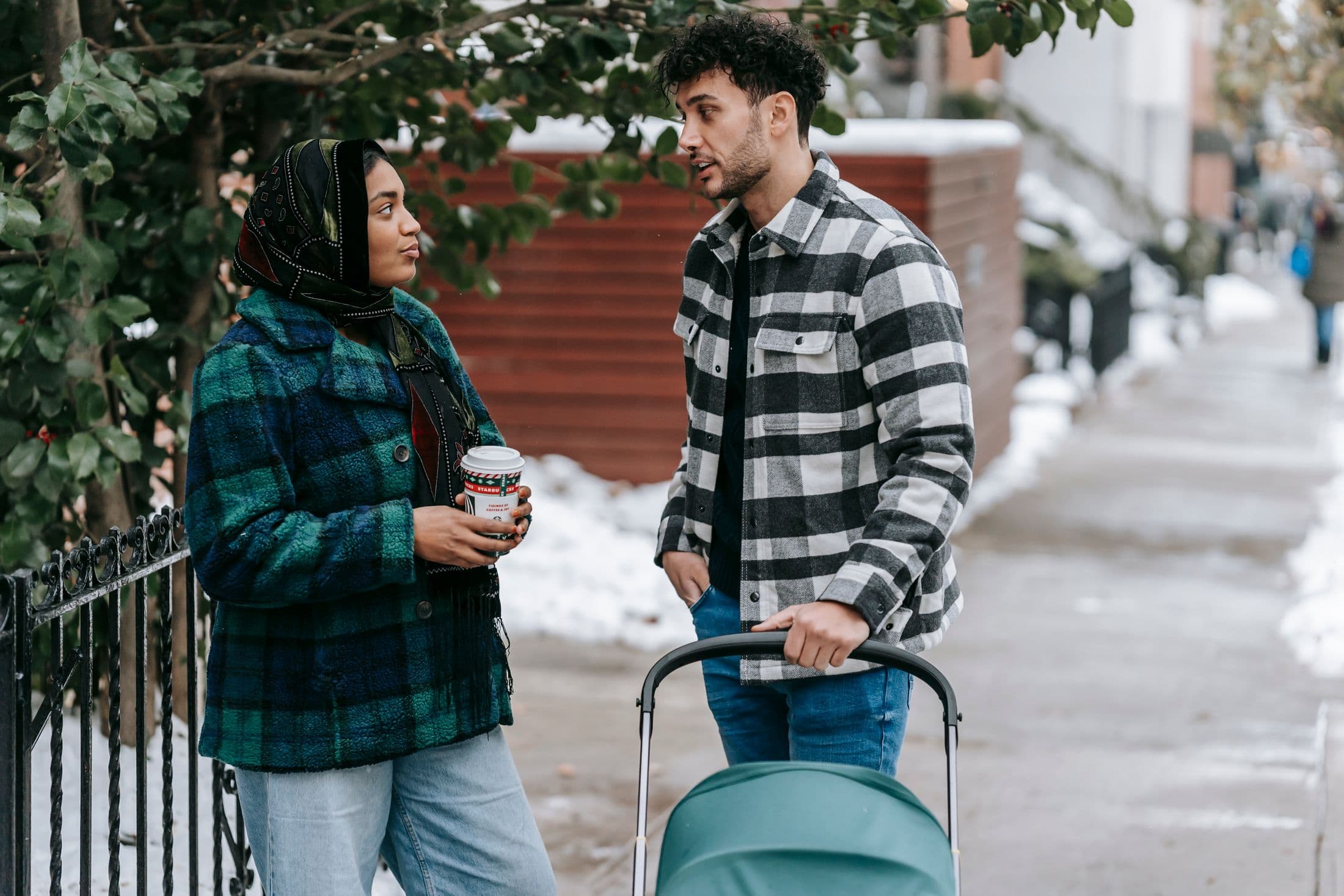
There is a very specific kind of loneliness that happens in a room full of other parents.
Not alone-alone. Not "I have not spoken to an adult all day" alone. The more irritating version, where you are standing in a school gym, surrounded by people whose lives overlap with yours in highly specific ways, and somehow you are still holding your water bottle like it is a social plan.
You recognize half the faces.
The mom from soccer. The dad from the class party. The parent whose child once came home with your child's sweatshirt and returned it folded, which felt more intimate than some medical appointments. The two moms laughing near the bleachers who seem to know where to stand, what to say, and whether tonight's event is the kind where people stay afterward or immediately flee to dinner and homework.
You could ask any of them a question that would actually matter.
What time does your kid go to bed?
Are you doing the phone thing yet?
Is the math homework making everyone cry, or just us?
Does after school feel like a tiny hostage negotiation in your house too?
Instead you say, "Can you believe this weather?"
Nobody can believe it. The conversation dies politely.
The focus group you cannot quite join
I read a recent essay in Scary Mommy by a mother who described this feeling almost perfectly: being surrounded by parents in the same school, same town, same stage of life, and still feeling outside the group.
What stuck with me was not the friendship part, exactly. It was the practical intelligence she wanted access to. She wanted to know how other families were handling homework, screens, bedtime, deodorant, teachers, sports, and the million tiny policy decisions that make up a household with school-age kids.
That is the funny thing about other parents. They are not just potential friends. They are a live, local, highly relevant operating manual.
They know the teacher.
They know the pickup line.
They know whether the after-school program actually lets out on time.
They know which birthday party venue is chaos, which soccer field has no bathrooms, which class email means "optional" in theory and "your child will be the only one without a shoebox diorama" in practice.
They are your closest available peer set.
And still, getting from "I recognize you" to "could we text sometimes?" can feel like asking someone to define the relationship in a dentist waiting room.
Proximity is not a relationship
Schools create repeated contact. They do not create intimacy.
You can stand next to the same parent every Tuesday for eight weeks and know nothing except that they own a navy puffer coat and their child also forgets the water bottle. You can sit through three basketball games near the same family and still not know whether it would be normal to say, "Want to sit together next time?"
This is where people underestimate the weirdness of parent social life.
In college, friendship had scaffolding. You lived near people. You had time to wander. You could sit on someone's floor for four hours pretending to study and accidentally become close. At work, there is at least a shared task. Even if you never become real friends, you have a reason to talk: the meeting, the project, the printer that has chosen violence.
Parent life has proximity without scaffolding.
The school gym is not a living room. The sideline is not a dinner table. Drop-off is not a coffee date. Everyone is arriving late, leaving early, answering a text, locating a sibling, or trying to remember whether the violin is in the trunk.
The relationship has no container.
So every small move feels strangely exposed.
Should I sit with them?
Should I ask for her number?
Should I invite them to something?
Was that too much?
Did I talk too long?
Do they think I am trying to become best friends, when really I just want to know if their kid also says school was "fine" and then melts down over a granola bar?
This is not adolescent insecurity in a Patagonia vest. It is a real design problem in modern family life.
Everyone is too tired to audition
The hardest part about making parent friends is that nobody has the spare bandwidth to be charming on spec.
You are trying to get to know another adult while one child is pulling on your sleeve, another child is asking for $4 from the concession stand, and the person you are talking to is half watching a younger sibling attempt to eat mulch. This is not the ideal setting for emotional nuance.
Then there is the self-editing.
You do not want to seem needy.
You do not want to seem too eager.
You do not want to interrogate someone.
You do not want to monologue.
You do not want to be the parent other parents inch away from at the art show.
And yet the alternative is small talk so thin it evaporates before anyone reaches the parking lot.
The result is that many parents are not without people. They are without a normal-feeling next step.
They have familiar faces. They have class lists. They have sidelines. They have WhatsApp threads full of logistics. What they do not have is a clean way to move one relationship one notch warmer without making it feel like a social performance.
Friendship is too big a first ask
"Do you want to be friends?" is not something adults say, which is unfortunate because it is often the thing everyone is circling.
Instead, parents try to reverse-engineer friendship through playdates, birthday parties, team snacks, committee signups, and the occasional brave text that says, "We should get together sometime," which is almost always true and almost never becomes a plan.
Friendship is a beautiful outcome. It is also a lot to ask of a relationship that currently consists of eye contact near a lost-and-found table.
That is why practical connection is often easier than social connection.
Not:
Want to become mom friends?
But:
Do you want to take the kids to the park after pickup Friday?
Not:
Can I be in the inner circle?
But:
Would it be useful to trade notes on the after-school program?
Not:
Please validate that I am not doing this whole parenting thing wrong.
But:
If either of us gets stuck at pickup, would it be okay to text about the walk home? Easy to say no.
The practical thing gives the relationship somewhere to stand.
It does not require instant chemistry. It does not require anyone to perform closeness. It does not ask the other parent to become your person. It just creates one small shared surface where two families can be a little less alone in the logistics.
The awkward parents are probably your people
There is a line of thought I keep coming back to: maybe the parents outside the inner circle are not failed insiders. Maybe they are the actual opportunity.
The parent standing alone at the game.
The one who talks a little too much because she finally found another adult.
The one whose jokes do not quite land.
The one who seems relieved when someone sits nearby.
The one who also does not know how this works.
Modern parenting has taught us to look for the polished group, the parents who already seem to have a system. But the parents who already have a system may not be the ones who need a new bridge.
The more interesting question is: who is standing close to the same problem without a way in?
The parent who is not your best friend but whose kid likes your kid.
The parent who also leaves work early on Thursdays.
The parent who lives three blocks away and keeps saying, "We really should do something sometime."
The parent who would probably say yes to a small, specific plan if the plan did not arrive dressed as a friendship proposal.
That is where a lot of real community begins. Not in the cool crowd. In the slightly awkward moment when one parent gives another parent a normal reason to connect.
Where Nura fits
Nura is not trying to manufacture best friends.
That would be an alarming product promise and also, frankly, a terrible onboarding flow.
Parents do not need an app that says, "Congratulations, here is your new village." They need help with the much smaller step that comes before that. The first real reason to text. The first bounded ask. The first shared plan that does not make either person feel trapped.
You might know a parent from the school gym and still need a reason to talk. A park plan after pickup on Friday gives you one.
A Friday park plan.
A walk home.
A note about after school.
A pickup backup that is specific, mutual, and easy to decline.
A Friday park plan can be the whole next step. Pickup is a separate conversation for another day.
Maybe friendship comes later. Maybe it does not. Either way, the relationship has moved from "face I recognize" to "parent I can text about one real thing."
That is not nothing.
For a lot of parents, it is the missing step.
If you want to start with your own afternoon, answer a few questions about your week.