
Somebody in a New York City parenting forum posted a very ordinary question. Their kid gets out at 2:40. They get home around 3:45. The school is four blocks from the apartment. What would you pay someone to cover that?
"How much would you offer to pick up your child and care for her for about an hour. The school is four blocks away from our home. They would pick her up at 2:40 and stay with her until I get home around 3:45."
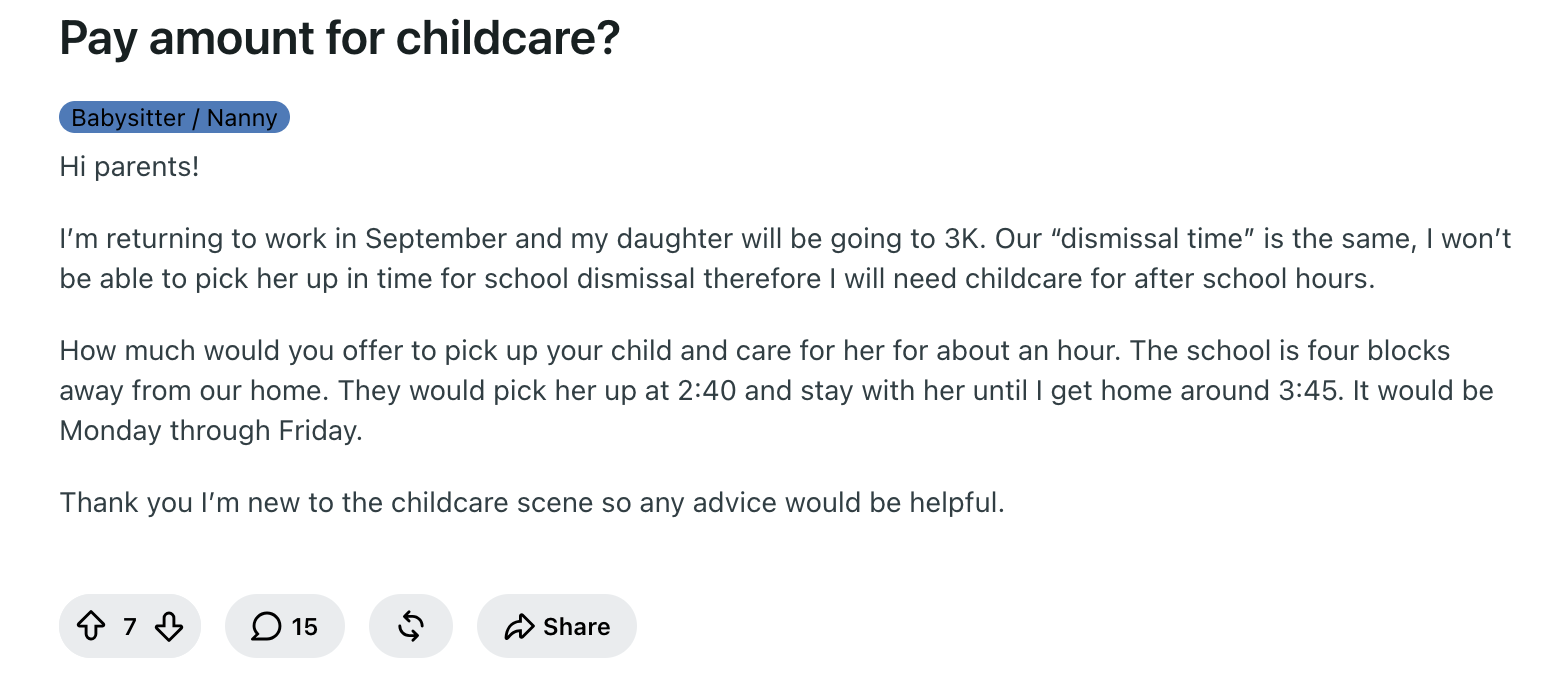
They filed it under the forum's "Babysitter / Nanny" tag. They are returning to work in September, their daughter is starting 3K, and they need the hour Monday through Friday. They sign off by saying they are new to all of this and would appreciate any advice.
Fifteen people replied.
Every single reply proposed paying somebody. A college student. A part-time sitter. A neighbor who could be hired. A nanny share with a family that has one.
Not one person said: there are twenty other families in that class walking out the same door at the same minute, and one of them lives on your block.
Look at the tag again. Babysitter / Nanny. The category was chosen before the question was written, and the category had answered it. Fifteen people were sorted into a room where the only available answer was a rate.
That is not a criticism of the people who answered. They were being practical, and they were answering the question that was actually posed. It is the question itself that is interesting. A parent describing a four-block walk and an hour with a snack reached for the word "pay" before anything else, and fifteen strangers agreed with the framing without noticing they were agreeing to anything.
What that hour costs
The pricing answer in the thread was blunt:
"For just an hour, you'll likely have to pay more than a standard hourly rate. I would guess at least $35/hr."
That is the going logic, and the math behind it holds. An hour of work stops being an hour once you count the trip there and the trip back. So a one-hour job pays a premium per hour and still loses to a three-hour job.
The number firmed up as parents who pay it weighed in. One said they pay $30 for the same kind of pickup and that $25 to $30 is the right range. Another said they have several college students doing pickup and drop-off and everyone seems happy at $30.
The guess was high. Care.com puts the average starting rate for a sitter in New York at $23.55 an hour, and the top of its range at $31.65, so $35 sits above what the city actually pays. The $25 to $30 these parents named is the real number.
And here is the strange part, which is the whole problem in one line. The posted rate for school pickup specifically is lower than the general sitter rate. Care.com's school-pickup category lists $20 an hour, the cheapest childcare category in New York. So the job is advertised cheap and paid dear. The gap between those two numbers is the fill rate.
There are 176 school days on the DOE calendar this year, September 10 to June 28. At $25 to $30 a day, that is somewhere between $4,400 and $5,300. For a walk and a snack.
And the paid version is openly unreliable
The same thread that proposed hiring also warned, unprompted, that hiring does not hold.
The parent who named the $25 to $30 range put the warning in the same breath. Finding someone reliable is hard, and even the most reliable will flake occasionally, more than a full-time nanny would, for a one-off school thing or a sick day or a vacation. Plan on flexibility at work, or backup options.
Another was shorter about it. If you do not pay people enough per week, they do not show up. The commenter had gone through many babysitters who decided a few afternoon hours were not worth their while.
The original poster's answer to both was four words. Yes, that is what I'm afraid of.
So the market's own recommendation, delivered by the market itself, is: hire someone, pay a premium, and then build a backup plan for the person you just hired.
Another parent in the thread, dealing with the mirror-image version of the problem, named the mechanism without meaning to.
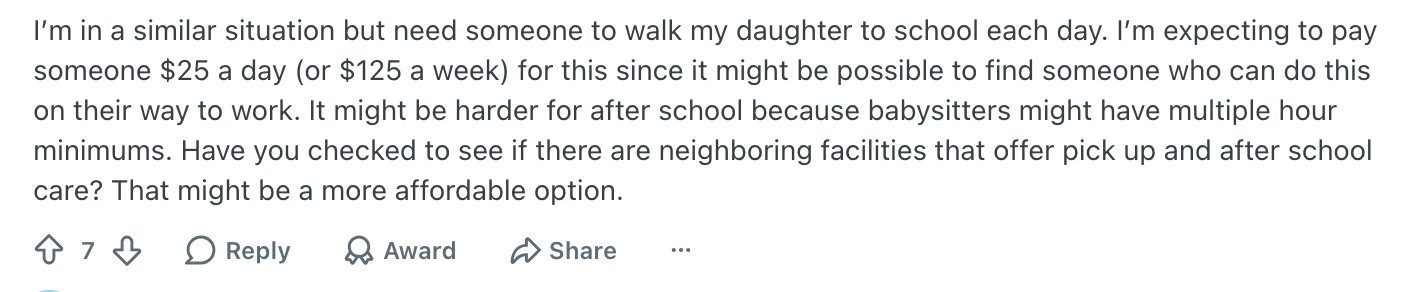
Multiple hour minimums. The morning walk can be bought because it fits inside somebody's existing commute. The after-school hour cannot, because it sits in the middle of the day and asks a person to build their afternoon around sixty minutes.
The minimum is usually four hours, and it is not one sitter being difficult. Bright Horizons, which sells back-up care to employers across the country, writes a four-hour minimum into its own in-home terms. So the hour is not really priced at $30. It is priced at four hours of somebody's afternoon, and $30 is what you pay when someone agrees to waive that. Not everyone will. In other threads, parents describe giving up on the search once they hit it, because the minimum was more hours than they needed and more money than they had.
One hour a day is a bad job. Too small to commute for, and first to be dropped when something better comes along. It attracts the least stable labor and then churns through it.
Meanwhile, someone is already walking to that school at 2:40. They have a kid in that building. They live in that neighborhood. Their marginal cost for four extra blocks and one more kid on the walk home is close to nothing.
Two replies got within arm's reach of this and then veered. One suggested finding another family who also needs pickup and doing a nanny share, which is peer coordination routed back through a paid person. Note the reason given for it, though. Not cheaper. More consistent coverage.
Reliability is the argument. Everybody in that thread knows it. Nobody follows the thought to the family standing next to them in line.
Why the silence makes sense
There is a decent explanation for why fifteen people skipped the most obvious option, and it is not that parents are selfish or that the other families would have said no.
In a Head Start program, researchers measured this directly. Parents came in willing to offer help to about eight other families in the classroom, and willing to request help from about four. Same parents, same room, same week. The number roughly halves when the arrow points the other way. When the program gave parents structured chances to meet each other, what moved was willingness to request. Willingness to offer barely budged, because it was never the problem.
The generosity is in the room. It is the requesting side that collapses.
There is a second layer underneath it. Flynn and Lake's research on help-seeking found that people underestimated by as much as 50% how likely others were to agree to a direct request. Half. People walk around with a systematically wrong model of how much yes is available to them, and they make decisions, including expensive ones, based on that wrong model.
Put the two together and the thread reads differently. Fifteen people did not fail to think of another family. They ran a quick internal calculation about what another family would say, got an answer that was probably off by a lot, and moved on to the option with a price tag, because a price tag is legible. You know what $30 a day buys. You know how to end it. Nobody has to feel anything about it.
What would have to be different
Not much, honestly. But the difference has to exist before 2:40 on a Tuesday, not during it.
The version that does not work is a parent standing outside the school with their phone out, deciding in real time how big a favor this is, whether they are bothering someone, whether they are supposed to offer something back, whether the other family will feel cornered, and what happens to the relationship if they say yes but resent it. That is a lot to work out while a kindergartner pulls on your coat.
The version that works answered the boring questions in advance:
- Which family is close enough to the moment that four extra blocks is not a detour.
- What exactly is being covered. The walk, or the walk and an hour, or the walk and an hour and a snack.
- How much notice is normal.
- What makes it too much.
- How the other person says no without it being an event.
- What flows back the other way, and when.
None of that requires a formal arrangement or a written agreement between neighbors. It requires the same thing that makes hiring feel simple: knowing the terms before you open your mouth.
What hiring really buys is a definition. Paid help arrives with the terms attached. Between two families, somebody has to supply them, and until somebody does, it stays in the category of things you would never bring up.
Where Nura fits
Nura is for the hour, not the afternoon.
If a family needs someone there from 2:30 to 6 every day, that is a real program or a real sitter, and Nura is not a substitute for either. But when the problem is one hour, five days, four blocks, the most reliable person in the picture is usually already in the picture. They just have not been given a specific, bounded, easy-to-decline reason to say yes.
Nura works on the arrangement. Which family. Which afternoons. What is actually covered, the walk or the walk and the hour. What goes back the other way. Whether this is ready to bring up at all, or whether it is too soon. The parent decides every piece of that, and nothing leaves her phone unless she sends it.
Fifteen people in that thread were solving for money. The parent who posted was solving for the same thing everybody else was: whether Thursday gets handled.
If you want to see how that works, plan one small gap.